
Key takeaways
- 01There is no single national price. Cost depends on the hours of cover, the officer's grade, the magisterial district and what the service includes.
- 02The wage floor is prescribed by grade and area: R7,003 a month for Grade C in Areas 1 and 2 from 1 March 2026 — but in Area 3, Grade B and Grade C share the same R6,726.
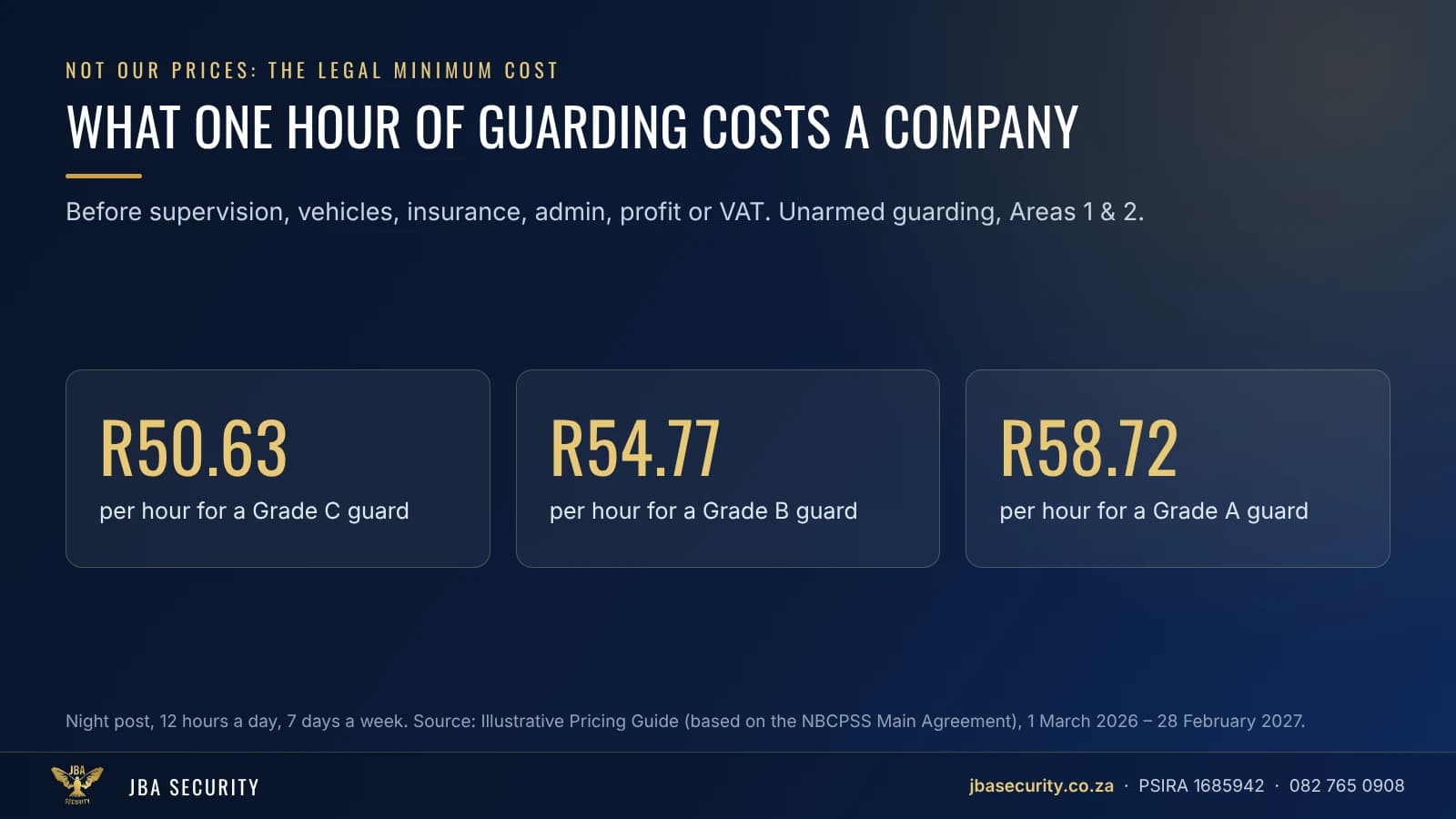
- 03The industry's pricing guide puts the illustrative direct employment cost of one 12-hour night post (84 hours of cover a week) at R18,479.61 a month for Grade C — an average of about R50.63 per hour of post coverage, which is not anyone's wage or tariff.
- 04That guide figure is not a statutory minimum price. It excludes overheads, profit and VAT, and it contains budgeting assumptions, not only fixed statutory amounts.
In this article
- 01The short answer
- 02What these figures are, and what they are not
- 03What kind of guarding this covers
- 04The prescribed wage floor, 1 March 2026 to 28 February 2027
- 05The full breakdown: where the R18,479.61 goes
- 06What is not in these numbers
- 07Day, night and continuous cover
- 08Hours of cover: 84 a week is not 168 a week
- 09Comparing quotations line by line
- 10Understanding your own risk, precisely
- 11Sources and method
- 12How JBA Security approaches this
- 13Get a clear, site-specific quotation
The short answer
There is no single national price for a security guard. What a staffed post costs depends on the roster, the officer's PSIRA grade, the magisterial district your site sits in, and what the service actually includes beyond the officer at the gate.
Two things can be stated precisely. First, the wage floor is prescribed: from 1 March 2026 a Grade C officer in Areas 1 and 2 must earn at least R7,003 a month. Second, the sector's bargaining council publishes an illustrative pricing guide showing what it costs to employ the officers for one staffed post — R18,479.61 a month for a Grade C 12-hour night post, or about R50.63 for every hour the post is covered.
| Guard grade (Areas 1 & 2) | Published hourly equivalent | Illustrative direct employment cost, per hour of cover* |
|---|---|---|
| Grade C, D & E | R33.67 | R50.63 |
| Grade B | R36.57 | R54.77 |
| Grade A | R39.35 | R58.72 |
\Illustrative direct employment cost for one 12-hour night post, seven days a week, under the assumptions in the NBCPSS Illustrative Pricing Guide (page 8, valid 1 March 2026 to 28 February 2027), divided by 365 average monthly hours of cover. Overheads, profit and VAT sit on top. See Sources and method.*
What these figures are, and what they are not
The prescribed minimum wages and the applicable employment obligations are mandatory. The pricing guide's total is a different kind of number. It is published by the National Bargaining Council for the Private Security Sector (NBCPSS) to help with costing, and it states on its own face: "PLEASE NOTE THAT THIS IS PURELY A GUIDE AND IS DISTRIBUTED WITHOUT PREJUDICE."
That total blends three things:
- Prescribed amounts — the monthly wage, the night-shift allowance of R8 per shift, the cleaning allowance of R32 per month, and the provident fund contribution rate of 7.5% from the employer and 7.5% from the employee, applied to the appropriate fund salary. (The guide's costing line carries the employer's 7.5%; the employee's own 7.5% is deducted from their pay, not an extra cost to the employer.)
- Statutory contributions at rates the guide has selected — UIF and SDL at 1%, and COID/WCA at 2.65% of remuneration in the 2026-2027 column.
- Budgeting assumptions and averaged provisions — a uniform budget of R3,000 per person a year, hospital cover of R172.50 a month, a PSIRA fee described as "R5.00 (average)", a long-service bonus averaged over 60 months, and leave provisions costed at 1.5 times to allow for a reliever.
So the guide's exact total is not a universal statutory minimum selling price. A provider with a different uniform cycle, a different COID assessment rate or a different relief model will have a different, equally lawful direct cost. What the guide is genuinely useful for is showing the shape of the cost: how little of it is the officer's basic wage, and how much is everything that lawfully comes with employing someone.
What kind of guarding this covers
These figures are for unarmed guarding — an officer at a gatehouse, at reception, or patrolling a site on foot. They do not cover armed response, armed officers, or control-room operators, all of which are costed differently.
The grade reflects the officer's PSIRA training and registration:
- Grade C: the standard grade for access control, gatehouses and site guarding. What most estates, business parks and warehouses use.
- Grade B: further training; often a shift leader or a higher-responsibility post.
- Grade A: the highest of these three; usually a site supervisor or officer in charge.
Grade and area have to be read together, because a higher grade does not always carry a higher wage floor. In Areas 1 and 2 each of the three grades does carry a different minimum. In Area 3, Grade B and Grade C, D and E share the same minimum of R6,726 a month — so there, moving an officer from Grade C to Grade B changes their registration and competencies but not the prescribed wage floor. The grade alone never tells you the minimum; the grade and the magisterial district together do.
The prescribed wage floor, 1 March 2026 to 28 February 2027
Minimum wages for the sector are set by the Main Collective Agreement of the NBCPSS and published by circular. For the period 1 March 2026 to 28 February 2027:
| PSIRA grade | Areas 1 & 2 — monthly | Area 3 — monthly |
|---|---|---|
| Grade A | R8,184.00 | R7,142.00 |
| Grade B | R7,607.00 | R6,726.00 |
| Grade C, D & E | R7,003.00 | R6,726.00 |
*Source: NBCPSS circular on minimum wages and allowances, 1 March 2026 to 28 February 2027 (8 February 2026).*
The same circular publishes hourly equivalents for Areas 1 and 2 — R39.35 for Grade A, R36.57 for Grade B and R33.67 for Grade C, D and E — with an express warning next to them:
The "hourly equivalent" figure below shall not be used to calculate the employee's ordinary salary in respect of ordinary hours worked, i.e., the employee's basic salary.
In other words, the monthly figure is the salary. The hourly equivalent is a conversion for costing premiums and additional hours, not a wage rate to multiply up.
The full breakdown: where the R18,479.61 goes
This is the guide's own build-up for one post, 12 hours a night, seven days a week, Grade C, D and E, Areas 1 and 2, for 1 March 2026 to 28 February 2027. The guide's model staffs that post with a primary officer and a relief officer, both permanent employees.
Some rows below combine several of the guide's published lines so the table stays readable on a phone. Every amount shown is the guide's own figure, or the sum of its own figures, and the sub-amounts are given where we have added lines together. The total is the guide's, not ours.
| Cost item (one 12-hour night post, per month) | Amount |
|---|---|
| Primary officer, 4 shifts a week (48 ordinary hours) | R7,003.00 |
| Relief officer, 2 shifts a week (24 hours) | R3,501.50 |
| Sunday premium (R2,626.13) and public-holiday premium (R404.02) | R3,030.15 |
| Leave provisions — annual, sick, study, family responsibility | R1,565.57 |
| Night-shift allowance, long-service bonus, statutory annual bonus | R1,131.21 |
| UIF, SDL, provident fund, hospital cover, COID/WCA, council levy, PSIRA fee | R1,825.17 |
| Uniform provision and cleaning allowance | R423.00 |
| Illustrative direct employment cost per month | R18,479.61 |
*Source: Illustrative Pricing Guide, page 8 (Areas 1 and 2, urban), 1 March 2026 to 28 February 2027. Employment costs only. The guide then adds a share of overheads at 40% of direct cost — R7,391.84 — reaching an illustrative total of R25,871.45 a month, which still excludes profit and VAT. That 40% is the guide's own modelling assumption for overheads, not a mandatory markup, and a provider's real overhead recovery may be higher or lower.*
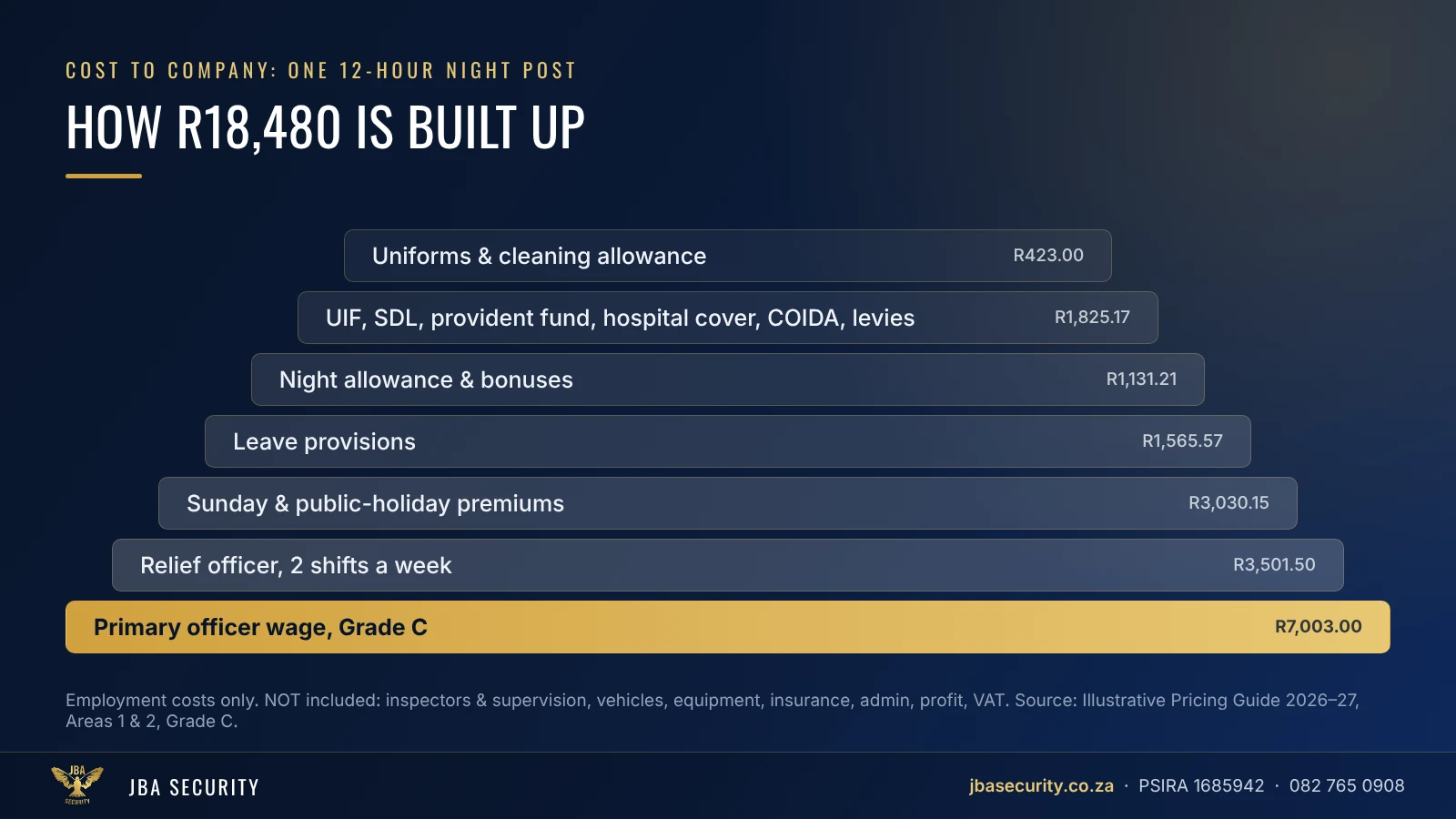
Our calculation: the two officers' basic salaries (R7,003 + R3,501.50) come to 56.8% of that total — about 57%. The rest is premiums, provisions and contributions that come with employing people lawfully.
How the per-hour figure is reached
The guide costs an "average month" of 12-hour shifts every day. The denominator follows from that:
12 hours × 365 days ÷ 12 months = 365 average monthly hours of cover.
Our calculation: R18,479.61 ÷ 365 = R50.63. The same division gives R54.77 for Grade B and R58.72 for Grade A.
Read that figure carefully. It is an average cost per hour of post coverage — what staffing the post costs, spread across the hours it is staffed. It is not an officer's wage, not an hourly rate payable to anyone, and not a tariff a client is charged.
What is not in these numbers
The guide's direct cost covers employing the officers and nothing else. It adds a separate "share of overheads" at 40% of direct cost, and states that it excludes profit and VAT.
| In the illustrative direct employment cost | Not included — added on top |
|---|---|
| Officers' wages (primary and relief) | Supervision and inspection visits |
| Sunday and public-holiday premiums | Control room and operations support |
| Leave, night allowance and bonuses | Patrol vehicles, fuel and maintenance |
| UIF, SDL, COID, provident fund, hospital cover, levies | Radios, phones and patrol verification devices |
| Uniform provision and cleaning allowance | Insurance and public liability cover |
| Training, recruitment and vetting | |
| Management, payroll, admin and offices | |
| The provider's profit, and VAT where applicable |
The guide also notes that maternity benefits are not in its structure.
Day, night and continuous cover
Each of these is one 12-hour post unless the row says otherwise, so the first two cover 84 hours a week and the third covers 168.
| Cover (Grade C/D/E, Areas 1 & 2) | Illustrative direct employment cost per month | Source |
|---|---|---|
| 12-hour night post, every day (84 h/week) | R18,479.61 | Published in the guide |
| 12-hour day post, every day (84 h/week) | about R18,225 | Our calculation |
| Day and night, continuous (168 h/week) | about R36,700 | Our calculation |
How the two derived figures were reached. The guide publishes only the night variant, and instructs "OMIT IF FOR DAY SHIFT" for the night-shift allowance. Removing that allowance (R243.33) also lowers the base on which the guide works out UIF, SDL and COID/WCA, so those three lines are recalculated rather than carried across unchanged. On that basis a day post comes to R18,224.47, which we show as about R18,225; a day post plus the published night post comes to R36,704.08, shown as about R36,700. Both assume the same grade, area, shift length and seven-day pattern as the guide's own column, and both are our arithmetic, not figures the NBCPSS publishes.
One note on precision, since it cuts the other way. Working the guide's own night-post column back up from its stated method gives R18,479.11 — fifty cents below the R18,479.61 it prints, because the guide rounds each line before adding. We quote the guide's published figure throughout. We are flagging the fifty cents rather than quietly replacing a source total with our own.
The grade and the area both move the monthly figure:
| One 12-hour night post, 7 days a week | Illustrative direct employment cost |
|---|---|
| Grade C, D & E — Areas 1 & 2 | R18,479.61 |
| Grade B — Areas 1 & 2 | R19,989.50 |
| Grade A — Areas 1 & 2 | R21,431.90 |
| Grade C, D & E — Area 3 | R17,787.16 |
Source: Illustrative Pricing Guide, pages 8 and 9.
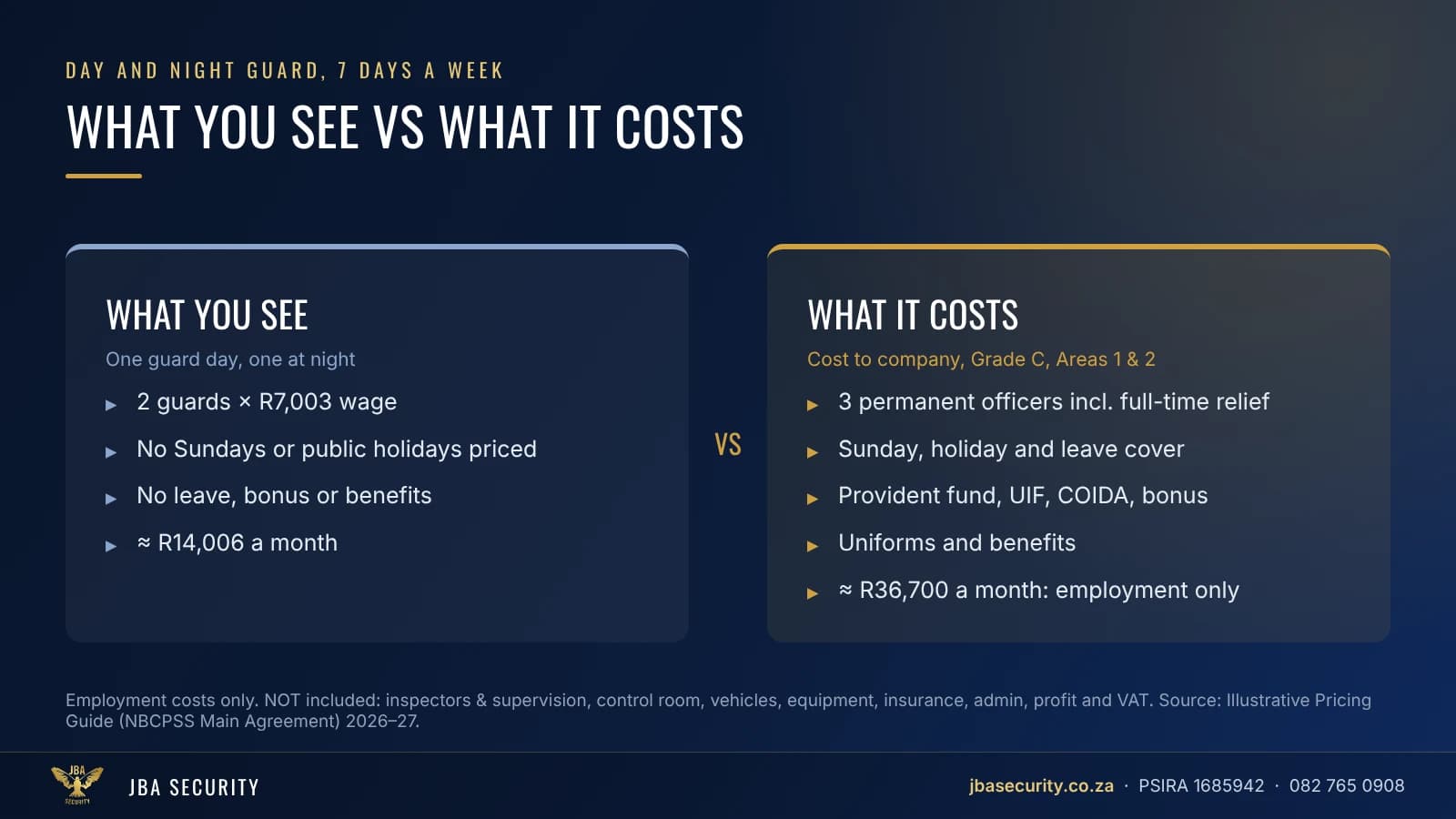
This is where quotations are most often misread. Two salaries of R7,003 suggest about R14,000 a month for "one officer by day, one by night". The staffing cost of keeping both posts covered every day of the month is more than two and a half times that, before a provider has paid for a single vehicle, inspection visit or insurance policy.
Hours of cover: 84 a week is not 168 a week
Two things get called "one post" and they are not the same size.
| What you are buying | Hours of cover per week |
|---|---|
| One 12-hour post, staffed every day | 84 hours (12 × 7) |
| One post covered 24 hours a day | 168 hours (24 × 7) |
The illustrative pricing guide costs the 84-hour case: a single 12-hour shift, every day of an average month. Continuous cover is double that, and costs roughly double, which is why a quotation for "a guard at the gate" needs to say how many hours it actually covers before any figure means anything.
What the agreement sets, and what it does not
These provisions come from the Main Collective Agreement as gazetted (Gazette 50065, 2 February 2024, in force to 28 February 2027):
- Ordinary hours. A security officer may not be required or permitted to work more than 48 ordinary hours in any week and, subject to that, 12 hours on any day (clause 7(1)(a)). Ordinary hours and overtime may be averaged over up to four months by written agreement (clause 7(2)).
- Overtime. Only by agreement, and limited to 3 hours a day or 10 hours a week — extendable to 12 hours a week by written agreement (clause 7(8)). It is paid at not less than one and a half times the hourly equivalent (clause 7(9)).
- Rest. A daily rest period of at least 12 consecutive hours, and a weekly rest period of at least 36 consecutive hours (clause 7(10)), with limited variations by written agreement.
- Sunday. Work on a Sunday is paid at double the employee's salary for each hour worked — unless the employee ordinarily works on a Sunday, in which case it is one and a half times (clause 10(1)). "Sunday work" means a shift that commences on a Sunday where at least half of it is ordinarily performed on that Sunday.
Set against that, 168 hours of continuous cover is more than three officers' ordinary hours: at 48 hours each, three officers supply 144, so continuous cover needs about three and a half officers' worth of ordinary time. The balance has to come from somewhere lawful — additional hours within the overtime limits, or more people.
Comparing quotations line by line
Once you know the shape of the cost, a quotation becomes readable. The question is not "is this cheap?" but "what is in it, and what is left over for everything the officer does not do?"
A worked example, using the guide's figure rather than any real quotation: if a provider quotes R21,000 a month excluding VAT for one Grade C night post, and the illustrative direct employment cost is R18,479.61, then roughly R2,520 is left to cover supervision, vehicles, the control room, insurance, administration and profit. Whether that is realistic is a judgement — but it is a judgement you can now make.
Ask every provider to confirm the same nine things, so the quotations can be laid side by side:
| What to confirm in writing | Why it matters |
|---|---|
| Hours per shift | Sets the hours of cover being priced |
| Days per week | A 7-day post costs materially more than 5 |
| Officer grade | Each grade carries a different prescribed wage |
| Relief and absence cover | Who stands the post on days off, leave and sick days |
| Supervision | How often a supervisor attends, and whether it is in the price |
| Equipment | Radios, patrol devices, vehicles — included or extra |
| Statutory contributions | UIF, SDL, COID, provident fund, council levy |
| Exclusions | What is explicitly not in the price |
| VAT treatment | Whether figures are inclusive or exclusive |
What to request and verify independently
Registration and ongoing compliance are different things. A registration number shows a provider was registered; it does not show that wages, contributions and levies are current. Ask for both, and verify them with the issuing body rather than accepting a copy at face value:
- Current PSIRA registration and compliance status for the business, confirmed with PSIRA
- PSIRA registration and appropriate grades for the officers who will actually be deployed
- Current NBCPSS compliance evidence
- Provident-fund compliance and evidence of contributions
- A COIDA Letter of Good Standing, in date
- Insurance cover — the schedule, the limits and the exclusions
- A written roster, with the absence and leave relief plan
- An itemised scope: hours, posts, supervision, equipment, exclusions and VAT treatment
Understanding your own risk, precisely
It is worth separating three things that often get run together.
What the Act actually says. Section 20(1)(a) of the Private Security Industry Regulation Act 56 of 2001 provides that no person may render a security service for remuneration, reward, a fee or benefit unless registered as a security service provider. Section 38(3)(g) makes it an offence to "knowingly or without the exercise of reasonable care contract for the rendering of security services contrary to a provision of this Act or the Levies Act", and section 38(3)(iii) sets the penalty for that paragraph at a fine or imprisonment not exceeding 24 months, or both.
We checked the amendment position before relying on those sections. The Private Security Industry Regulation Amendment Act 18 of 2014 was assented to in September 2021, but its provisions remain uncommenced, awaiting proclamation — and in any event it does not amend section 20 or section 38. So the wording above is the operative wording.
Two limits on what that means for you. The offence is about contracting contrary to the Act, knowingly or without reasonable care — accepting a low price is not itself that offence. And confirming registration is the obvious first step in exercising reasonable care, but it is not a complete answer to it: what reasonable care requires depends on the circumstances, and a registration check on its own does not settle every question about a provider's compliance.
Contract and insurance matters. Whether you carry any exposure for a provider's conduct, and whether your own insurance responds to an incident at a guarded site, turns on your contract wording and your policy terms. Those are specific to your documents, and this page makes no claim either way about what they say. Read them, and take advice on them if the answer matters.
Operational risk. This is usually the practical one. A post with no genuine relief plan produces officers working excessive hours, fatigue on night shifts, unfilled shifts when someone is sick, and thin supervision. That shows up as a gate left unattended at 3am, long before it shows up in a legal dispute.
Sources and method
Reviewed on 27 October 2026 against the following published sources.
- NBCPSS circular: increases in minimum wages and allowances, 1 March 2026 to 28 February 2027 (8 February 2026) — the prescribed monthly wages for both area bands, the published hourly equivalents and the warning about their use, the night-shift and cleaning allowances, and the 7.5% provident fund rate.
- NBCPSS Main Collective Agreement, as gazetted in Government Gazette 50065 of 2 February 2024 and extended to non-parties, in operation until 28 February 2027. Clauses read directly: 1(4) (the wage area follows where the employee works), 4(1)(a)(i) and 4(5) (hourly equivalents and the (x ÷ y) × 3/13 formula, and that they are not to be used for ordinary salary), 7(1) (48 ordinary hours a week, 12 a day), 7(2) (averaging), 7(8) and 7(9) (overtime limits and the 1.5× rate), 7(10) (12-hour daily and 36-hour weekly rest), and 10(1) (Sunday at double, or 1.5× where the employee ordinarily works Sundays). The 2024 summary of amendments changes none of those provisions.
- NBCPSS Illustrative Pricing Guide 2023-2027 — page 8 for Areas 1 and 2, page 9 for Area 3, both headed "valid from 1 March 2026 until 28 February 2027". Earlier pages cover 2023-2026 and carry different figures.
- Private Security Industry Regulation Act 56 of 2001 — sections 20(1) and 38(3). The Private Security Industry Regulation Amendment Act 18 of 2014 was assented to in September 2021 but remains uncommenced, and does not amend either section, so the principal Act's wording is the operative wording.
- PSIRA — for the registration and industry-conduct side, which is separate from the wage and employment obligations above.
Method. Per-hour figures divide the guide's monthly direct cost by 365 average monthly hours of cover (12 hours × 365 days ÷ 12 months). Anything labelled "our calculation" is our own arithmetic on the guide's method and assumptions, not a figure the NBCPSS publishes; source figures are quoted as published, and where our reproduction differs we say so rather than substituting our own number.
What we have not verified. We have not examined any individual employer's payroll, roster or compliance status, and nothing here is a statement about any particular provider. This page is general information about how guarding is costed and what the published instruments say. It is not legal advice: the application of the Act, the agreement, your contract or your insurance to your own situation needs advice on your own documents and facts.
How JBA Security approaches this
JBA Security has been operating since 2008 and is PSIRA-registered (1685942). Our director, Johan Brits, spent 23 years in the South African Police Service. Our approach is simple: "Old-school discipline. Modern security technology."
We start every quotation with a site visit, and build it from the posts, hours and grades the site actually needs rather than from a per-guard rate. We pay in line with the NBCPSS Main Agreement, and we itemise what is in a quotation and what is not. We provide security guarding for estates and residential developments and for commercial and industrial sites across the Western Cape and Gauteng.
If you are still shortlisting providers, our guide to how to choose a security company in South Africa covers the vetting steps in more detail.
Get a clear, site-specific quotation
If you need guarding at an estate, business park, industrial site or development in Cape Town, the wider Western Cape or Gauteng, we are happy to look at what your site actually needs and put it in writing. Request a quote or book a site assessment, or call us on 082 765 0908.
Frequently asked questions
Are these JBA Security's prices?
No. The monthly wages are prescribed for the whole sector, and the cost build-up is taken from the NBCPSS Illustrative Pricing Guide, which is published as a costing aid rather than a price list. Every provider's own direct cost differs with its relief model, uniform cycle and COID assessment, and every quotation then adds overheads, profit and VAT. We quote after a site visit.
How much does a security guard cost per hour in South Africa?
There is no single national hourly price. For context: the published hourly equivalent for a Grade C officer in Areas 1 and 2 is R33.67 from 1 March 2026, and the pricing guide's illustrative direct employment cost for a 12-hour night post works out at an average of about R50.63 per hour of post coverage once relief, premiums, leave provisions and contributions are included. That average is not an officer's wage and not a client tariff — overheads, profit and VAT are additional, and your own figure depends on the hours, grade, area and site.
Is the pricing guide's total a legal minimum price?
No. The prescribed wages and applicable employment obligations are mandatory, but the guide's total also includes budgeting assumptions, averaged fees and provisions, and the guide itself is "purely a guide and is distributed without prejudice". It is a reasonable benchmark for what staffing a post costs, not a statutory floor on what may be charged.
Is this the cost of armed response?
No. These figures are for unarmed officers doing access control, gatehouse, reception or foot-patrol work. Armed officers, armed response and control-room operators are costed separately and cost more.
How many officers do I need for a post staffed day and night?
There is no fixed answer, and anyone who gives you one without seeing your site is guessing. The arithmetic that does hold: continuous cover is 168 hours a week, while the Main Collective Agreement caps a security officer at 48 ordinary hours a week (clause 7(1)(a)). Three officers' ordinary hours come to 144, so continuous cover needs about three and a half officers' worth of ordinary time, with the balance coming from overtime within the limits in clause 7(8) or from more people. The actual number depends on your roster, the 12-hour daily and 36-hour weekly rest periods, leave and absence cover. Ask for the roster and the relief plan in writing.
Does a higher grade always cost more?
No. The minimum depends on the grade and the wage area. In Areas 1 and 2 the three grades do carry different minimums, but in Area 3 Grade B and Grade C, D and E share the same R6,726 a month, so upgrading an officer there changes their registration and competencies without changing the prescribed wage floor. Grades are a PSIRA matter; wages come from the NBCPSS agreement.
What is the minimum wage for a security guard in 2026?
From 1 March 2026 to 28 February 2027 the prescribed monthly minimum is R7,003 for Grade C, D and E officers in Areas 1 and 2, and R6,726 in Area 3. Grade B is R7,607 and R6,726; Grade A is R8,184 and R7,142. Areas are defined by magisterial district.
What should I do if one quotation is much cheaper than the others?
Ask for it in writing: the roster, the grade, the wage area, the wage assumptions, the statutory contributions and the exclusions. A lower figure can be entirely legitimate — a five-day rather than seven-day post, fewer hours, a different grade or area, or a different but still lawful relief arrangement. What cannot explain it is lower overheads, because overheads sit on top of the direct employment cost rather than reducing it. Compare only quotations built on the same hours, area, grade and scope.

About JBA Security
JBA Security is a locally owned, PSIRA-registered (1685942) security company protecting estates, business parks, industrial and development sites across the Western Cape and Gauteng since 2008. The business is led by director Johan Brits, who served 23 years in the South African Police Service.
Old-school discipline. Modern security technology.