
Key takeaways
- 01Start with registration: PSIRA for the business and for every officer who will be deployed. Verify it with PSIRA, not from a copy.
- 02Then ask whether the price can staff the post. Compare against a published benchmark rather than against the other quotes.
- 03Ask who supervises the officers, how often, and who answers the phone at 2am.
- 04Registration is not the same as ongoing compliance. Ask for current COIDA, provident-fund and bargaining-council evidence too.
In this article
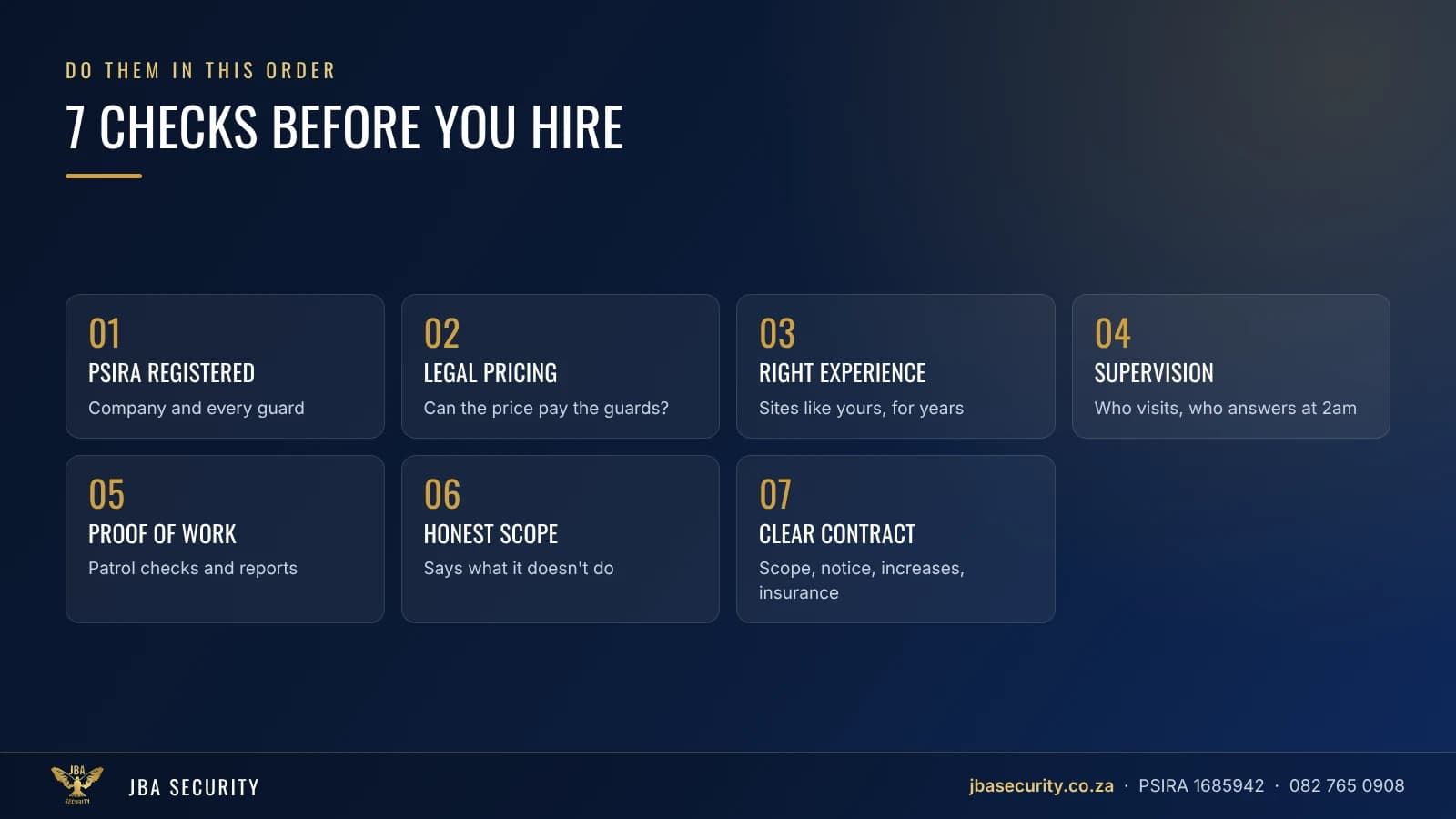
- 01Check 1: Is the business registered with PSIRA?
- 02Check 2: Can the price actually staff the post?
- 03Check 3: Has the company done sites like yours?
- 04Check 4: Who supervises the officers?
- 05Check 5: How will you know the job is being done?
- 06Check 6: Does the company say what it does not do?
- 07Check 7: Read the contract before you sign
- 08Registration is not the same as ongoing compliance
- 09Questions to ask when something looks off
- 10Sources and method
- 11How JBA Security approaches this
- 12Talk to us about your site
Choosing a security company gets much easier if you do it in order. First confirm that the business and its officers are registered. Then work out whether the price can actually staff the post you are buying. Only then weigh experience, supervision, reporting and cost against each other.
This guide walks through seven checks in plain language. It is written for estate managers, HOAs and body corporates, property and facility managers, developers and business owners who need a provider they can rely on for years rather than months.
Check 1: Is the business registered with PSIRA?
Section 20(1)(a) of the Private Security Industry Regulation Act 56 of 2001 provides that no person may render a security service for remuneration unless registered as a security service provider. That covers both the business and the individual officers.
Ask for the registration numbers and grades of the officers who will actually be deployed on your site, and verify them directly with PSIRA rather than relying on a certificate you have been handed. Our guide to verifying a security company's PSIRA registration walks through the letter of good standing, its 90-day validity and — importantly — what it does not cover.
Check 2: Can the price actually staff the post?
A low quote is worth understanding rather than dismissing. Officers' minimum wages are prescribed through the NBCPSS Main Collective Agreement: from 1 March 2026 to 28 February 2027, a Grade C officer must earn at least R7,003 a month in Areas 1 and 2, and R6,726 in Area 3. Those areas are defined by named magisterial district, so check which one your site actually falls in — being in the same province as a listed district is not enough. Note too that a higher grade does not always mean a higher floor: in Area 3, Grade B and Grade C, D and E share the same R6,726.
The wage is only the first line. A staffed post also carries relief, Sunday and public-holiday premiums, leave provisions, bonuses, provident fund, UIF, SDL and COID. The sector's illustrative pricing guide puts the direct employment cost of one Grade C 12-hour night post at R18,479.61 a month — about R50.63 per hour of cover — before supervision, vehicles, insurance, administration, profit or VAT. Our security guard cost guide breaks that figure down line by line and explains what it is and is not.
Check 3: Has the company done sites like yours?
Different sites need different disciplines:
- A residential estate needs access control, visitor management, and officers who are courteous but firm with residents.
- A warehouse or distribution centre needs loss prevention, vehicle and delivery control, and strict shift discipline.
- A vacant or development site needs perimeter control and officers who prevent unlawful occupation.
Ask each company three questions:
- Which sites like ours do you look after right now?
- How long have you held those contracts?
- May we speak to one of those clients?
Check 4: Who supervises the officers?
Officers are only as good as the people managing them. Ask how often a supervisor or inspector attends your site, what they check, whether the visit is recorded, and who you phone at 2am.
A provider should be able to commit to:
- A named contact person for your site.
- Site inspections at a stated frequency, recorded in writing.
- A defined process when an officer misses a patrol or breaches site rules.
- Genuine after-hours support, not only office hours.
Confirm whether supervision is included in the price or billed separately — it is a common source of surprise on the first invoice.
Check 5: How will you know the job is being done?
You should not have to take patrols on trust. Ask how the provider evidences the work:
- Digital patrol verification records whether patrols happened, and when.
- Incident reporting tells you about a problem as it happens rather than at month end.
- Visitor and access records show who entered the site and when they left.
Ask to see a real sample report before you sign, and ask who receives it and how often. Technology does not replace good officers, but it does show you what they are doing.
Check 6: Does the company say what it does not do?
No provider does everything, and a straight answer about scope is a good sign. Some focus on guarding and access control, others on armed response or alarm monitoring. Make sure the company's core service is the one you need, and ask how anything outside it is handled.
On larger contracts some providers will coordinate your whole security setup and bring in specialist partners. That can be easier for you, provided the contract is explicit about who does what and who carries responsibility.
Check 7: Read the contract before you sign
Check these five things:
- Scope: how many posts, which hours, which grades, which duties.
- Service levels: what is promised, and what happens if it is not met.
- Notice period: how either side ends the agreement.
- Annual increases: sector minimum wages are adjusted annually, effective 1 March under the current agreement, so the contract should say how increases are passed through.
- Insurance: which cover is in place, at what limits, and with which exclusions.
Registration is not the same as ongoing compliance
A registration number shows a provider was registered. It does not show that wages, contributions and levies are current. Ask for both, and verify with the issuing body rather than accepting a copy:
- Current PSIRA registration and compliance status for the business
- PSIRA registration and grades for the officers to be deployed
- Current NBCPSS compliance evidence
- Provident-fund compliance and evidence of contributions
- A COIDA Letter of Good Standing, in date
- Insurance schedule — cover, limits and exclusions
- A written roster, with the absence and leave relief plan
- An itemised scope: hours, posts, supervision, equipment, exclusions and VAT treatment
Questions to ask when something looks off
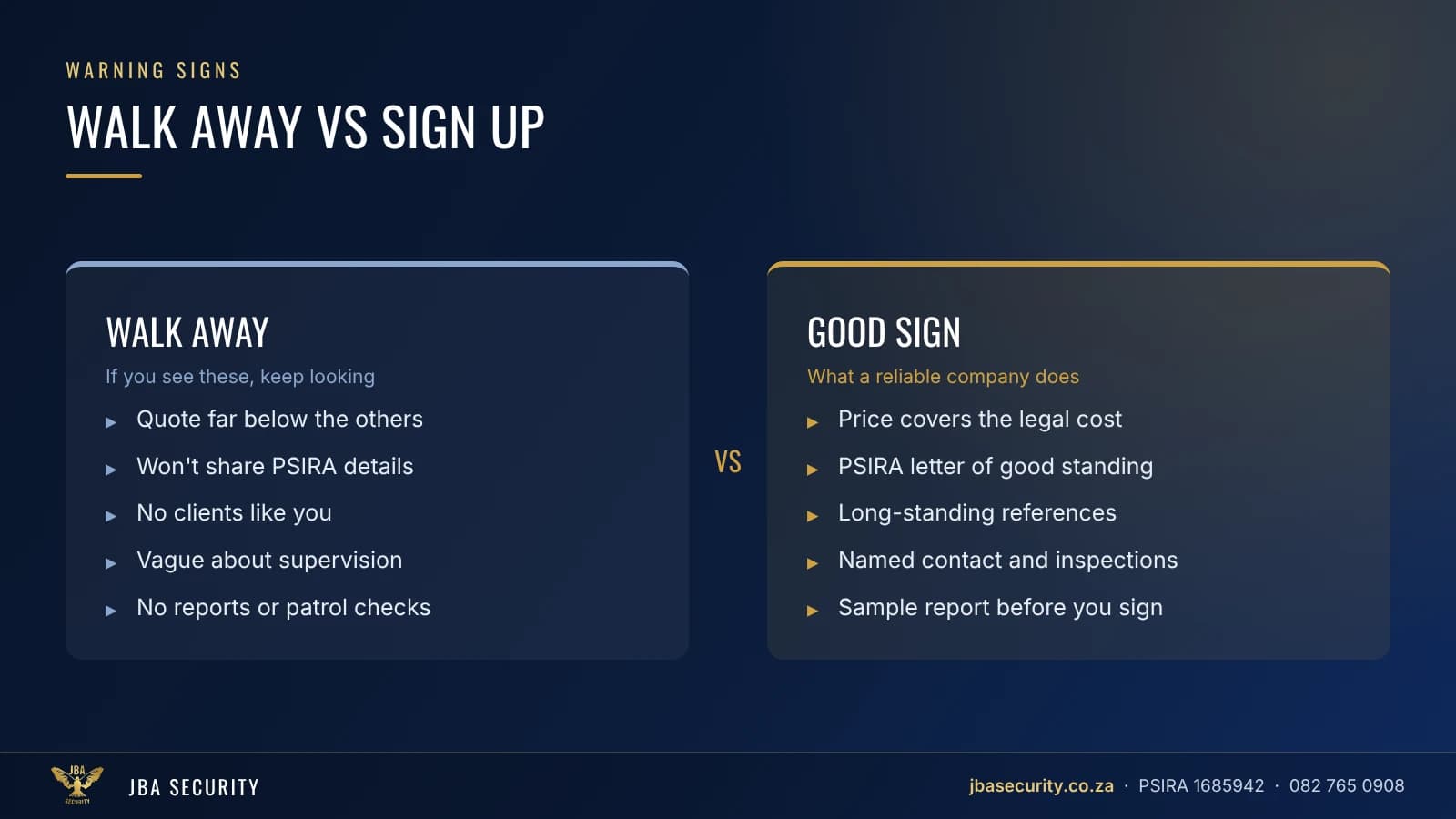
| What you notice | What to ask for in writing |
|---|---|
| A quote well below the others | The roster, grades, wage assumptions, contributions and exclusions |
| Reluctance to share PSIRA details | Registration numbers for the business and the deployed officers |
| No comparable sites | Current contracts of a similar type, and a contactable reference |
| Vague about supervision | Visit frequency, what is checked, and whether it is recorded |
| No reporting or patrol evidence | A real sample report, and who receives it how often |
| Claims to do everything in-house | Which work is subcontracted, to whom, and who carries responsibility |
Get the answers in writing and compare them on the same brief — same posts, same hours, same duties. Most of the difference between quotations turns out to be scope, not price.
Sources and method
The legal and wage figures on this page come from the following published sources, checked on 27 October 2026:
- Private Security Industry Regulation Act 56 of 2001 — sections 20(1) and 38(3)(g), quoted from the Act as published. The Act has been amended since 2001, so check a consolidated version before relying on section numbering.
- NBCPSS circular on minimum wages and allowances, 1 March 2026 to 28 February 2027 — the prescribed monthly wages and the magisterial districts that define each area.
- NBCPSS Illustrative Pricing Guide 2023-2027 — page 8 for the Areas 1 and 2 direct-cost build-up used as the benchmark above.
- Labour Relations Act 66 of 1995 — section 197(1) and (2).
Nothing on this page is legal advice. For a view on your own contract, insurance or obligations, take advice on your documents.
How JBA Security approaches this
JBA Security is a locally owned, family-led company, operating since 2008 and registered with PSIRA (1685942). Our director, Johan Brits, served 23 years in the South African Police Service. We work across the Western Cape, including Cape Town, Bellville, Brackenfell, Stellenbosch and Paarl, and in Gauteng.
We focus on what we do well: security guarding, access control, patrol officers and security technology for estates and residential developments and commercial and industrial sites. We do not offer armed response or run a monitoring centre ourselves. On larger contracts we can coordinate the whole security setup and bring in specialist partners.
Residentia Trust has used us as a preferred contractor since 2009 across Brackengate Business Park, Northgate Estate and Icon Park. You can read more on our clients page.
Talk to us about your site
If you are reviewing security for an estate, business park or industrial site, we would be glad to help you compare your options properly. Request a quote or book a free site assessment, or call 082 765 0908.
Frequently asked questions
What is the most important thing to check when choosing a security company?
Registration, first. Section 20(1)(a) of the Private Security Industry Regulation Act requires anyone rendering a security service for remuneration to be registered as a security service provider, and that covers both the business and the officers deployed. Verify it with PSIRA directly, then move on to costing, supervision and reporting.
Should I choose the cheapest security company?
Not on price alone, and not by assuming the cheapest is cutting corners either. Ask every provider to quote the same posts, hours, area and duties, then ask the lowest one to explain its roster, wage assumptions, statutory contributions and exclusions in writing. A lower figure can be entirely legitimate — a shorter week, fewer hours, a different grade or wage area, or a different but still lawful relief arrangement. Lower overheads are not an explanation, since overheads sit on top of the direct employment cost rather than reducing it.
How many quotes should I get?
Three is a practical number. Give every company the same written brief covering posts, hours, grades and duties, so you are comparing like with like rather than comparing scopes.
What does it cost to staff a security post?
The sector's illustrative pricing guide puts the direct employment cost of one Grade C 12-hour night post in Areas 1 and 2 at R18,479.61 a month, or about R50.63 per hour of cover, for 1 March 2026 to 28 February 2027. That covers employing the officers only — supervision, vehicles, insurance, administration, profit and VAT are additional. It is a costing benchmark rather than a statutory minimum price, and your own figure depends on the roster and the site.
How do I check whether a security company is compliant, not just registered?
Registration and ongoing compliance are different. Ask for current PSIRA registration and compliance status, NBCPSS compliance evidence, provident-fund contribution evidence and an in-date COIDA Letter of Good Standing — and confirm each with the issuing body rather than accepting a copy.
What happens to the existing guards if I change provider?
It depends on the facts. Section 197 of the Labour Relations Act transfers contracts of employment where a business or service is transferred as a going concern, but whether replacing a service provider meets that test is fact-specific and has been litigated. Get legal advice on your situation before you give notice.

About JBA Security
JBA Security is a locally owned, PSIRA-registered (1685942) security company protecting estates, business parks, industrial and development sites across the Western Cape and Gauteng since 2008. The business is led by director Johan Brits, who served 23 years in the South African Police Service.
Old-school discipline. Modern security technology.