New PSiRA Reporting Rules: Why Your Security Provider's Payroll Records Matter to Your Estate
17 August 2026
Every officer standing at your boom gate sits at the end of a paper trail you almost never see: a PSiRA registration, a payroll entry, a tax submission and a deployment record. For years, most trustees and facility managers treated that paperwork as the provider's private business. A change to South Africa's private-security regulations, in force since 1 April 2026, is a good reason to look a little closer.
The change is easy to miss because it arrived inside a notice about annual fees. The Private Security Industry Regulatory Authority amended the regulations made under the Security Officers Act, and among the fee provisions sits a substantially expanded monthly reporting duty for every security business.
What actually changed
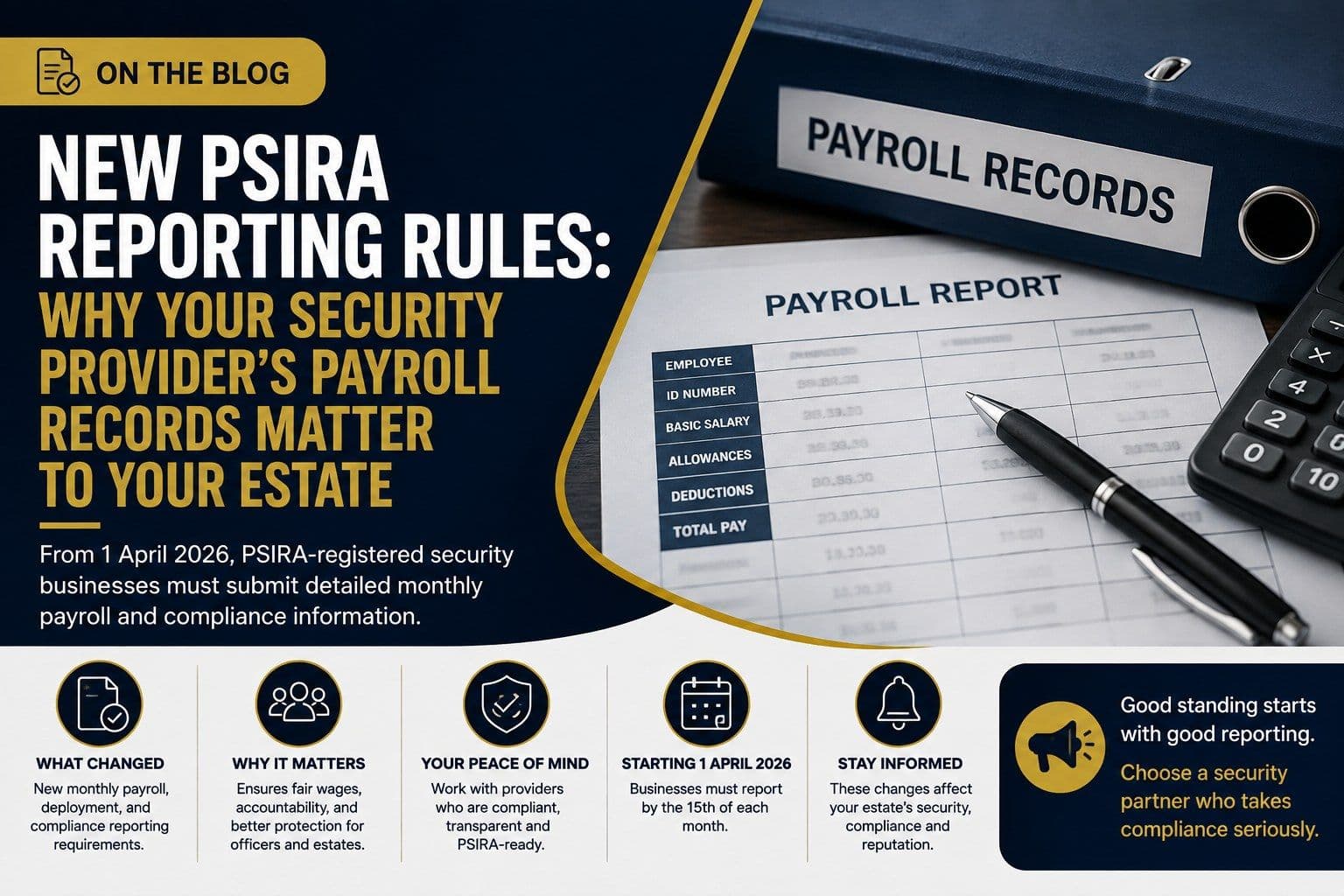
Under the amended regulation, on or before the 15th of each calendar month a security business must give PSiRA a signed return covering every security officer it employed, used, deployed or made available during that month. The return includes each officer's full names, identity numbers, contact numbers, PSiRA registration numbers, the period of their service that month and the geographic area where they served.
By the same date, the business must submit its completed SARS Monthly Employer Declaration (EMP201) together with a detailed supporting reconciliation generated by its payroll. If the business has subcontracted work to another security firm, or is operating through a joint venture, it must disclose that arrangement and submit the relevant EMP201.
Meeting these obligations is linked to the issue of a letter of good standing. The regulations also carry penalties where a business fails to file a return, files one that does not materially comply, or submits a return that is false or misleading.
Why this concerns your property, not just your provider
You are not the one filing these returns — so why does it matter to a homeowners' association or a commercial-park manager? Because the return is, in effect, a monthly cross-check of whether the guards on your site are properly registered, correctly paid and lawfully deployed.
When rosters, payroll, site attendance records and PSiRA submissions all line up, that consistency is a quiet signal of a well-run operation. When they do not, the gaps raise fair questions. An officer on your night shift who does not appear on a payroll reconciliation, or a registration number that cannot be produced, is the kind of discrepancy that now carries a regulatory dimension as well as an operational one.
The cheapest quote can carry a hidden cost
Compliant guarding has a cost floor. Lawful wages, statutory contributions, PSiRA fees and the administration behind accurate monthly reporting all have to be paid for out of the rate you agree. A quotation that sits well below the market often has to absorb that gap somewhere — and the usual places are wages, registration or the reconciliation work itself.
That does not make every low bid non-compliant, and price alone is not proof of anything. It simply means the lowest number on a comparison sheet deserves a second question: can this rate realistically support compliant labour and reporting?
A practical checklist for HOAs, estate managers and procurement teams
Before you appoint or renew a guarding provider, ask to see:
- Valid PSiRA business registration and a current letter of good standing.
- The PSiRA registration numbers for the specific officers deployed to your site.
- Confirmation that the monthly return is submitted by the 15th.
- Confirmation that EMP201 and a payroll reconciliation are filed as required.
- Written disclosure of any subcontracting or joint-venture arrangement affecting your site.
- Site deployment records that reconcile to the roster and to payroll.
Keep this list with your contract file and revisit it at renewal, not only at appointment.
Accountability without over-exposing guards' information
Transparency should not mean collecting a pile of officers' personal data at your gatehouse. The amended regulations require that the information reported to PSiRA is handled in line with the Protection of Personal Information Act. You can apply the same discipline: confirm a provider's registration and reporting status, and verify that named officers are registered, without your committee retaining copies of ID numbers or payslips it does not need. Good accountability and sensible data minimisation work together.
Where an operational partner adds value
A guarding provider that treats reporting as routine — rather than a scramble on the 14th of each month — is usually one whose deployment, payroll and supervision are already aligned. JBA Security has operated as a security guarding company in the Western Cape and Gauteng since 2008, including estate and residential security, and we keep site deployment, payroll and PSiRA reporting reconciled as part of normal operations — old-school discipline supported by modern security technology.
This article is general information, not legal advice; every estate and business should obtain advice based on its own circumstances and contracts.
If your committee or procurement team would like to pressure-test a provider's compliance documentation — or review your own — contact JBA Security for a compliance-focused discussion. We are happy to walk through what good documentation looks like, whether or not you appoint us.
Frequently asked questions
Are the new PSiRA reporting rules already in force?
Yes. The amendment was gazetted on 16 March 2026 and took effect on 1 April 2026.
What is a PSiRA letter of good standing?
It is a confirmation from the Authority that a security business has met specified obligations. Under the amended regulations, monthly reporting is tied to it.
Can I ask my provider for proof of compliance without breaching guards' privacy?
Yes. You can confirm registration and reporting status without your committee collecting officers' personal identity details itself.
Sources consulted
- Amendment of the Regulations made under the Security Officers Act, 1987 — Private Security Industry Regulatory Authority, Department of Police. Government Gazette No. 54323, General Notice 3825 of 2026, published 16 March 2026 (commencement 1 April 2026). gov.za
- Protection of Personal Information Act 4 of 2013 (POPIA) — referenced in the amended regulation regarding the handling of reported information.
More Insights
That Online Bargain Could Be a Trap: How South Africans Can Shop More Safely
A price that looks too good to be true can cost far more than expected. Following a recent SAPS warning in Tshwane, here are practical checks every online shopper should know.
Read More →When a Hijacking Becomes a Kidnapping: Safety Lessons for Gauteng Motorists
A recent Tshwane rescue is a reminder that a hijacking can escalate rapidly. These practical habits can help motorists reduce risk before, during and after a threatening encounter.
Read More →Extortion Is Not Only a Big-Business Problem: What Western Cape Owners Should Know
A multi-agency operation and four arrests have put extortion back in the spotlight. Here is what Western Cape owners, managers and staff should know before a demand arrives.
Read More →Is Your Current Security Provider Truly Accountable?
Book a no-obligation site security assessment with JBA Security.