

Guards and technology aren't a trade-off. The estates with the strongest security track record combine both, using technology to make each guard shift more effective rather than trying to replace guards altogether.
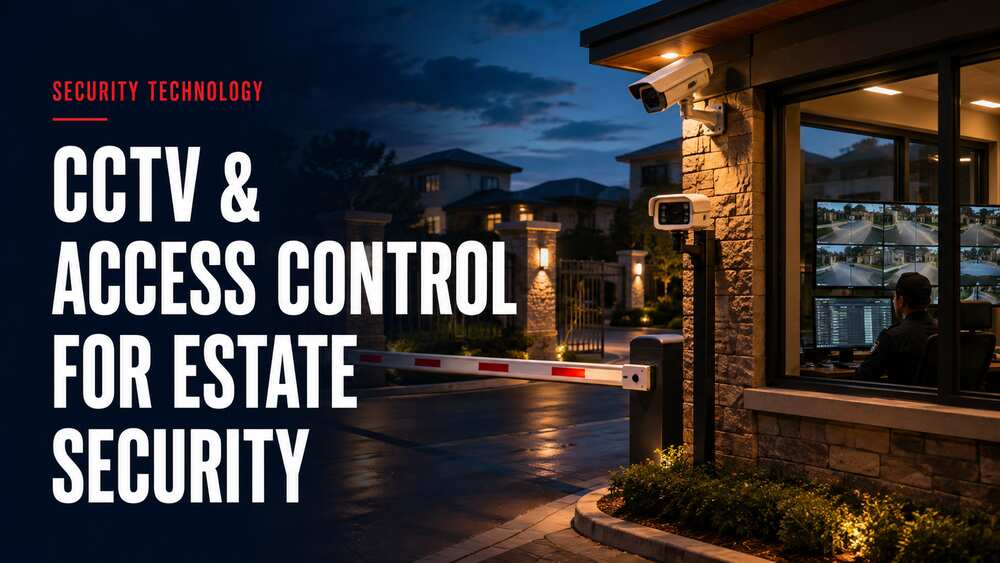
Take access control. A boom gate with a guard checking ID manually is only as reliable as that one person's attention over an 8-12 hour shift. Automated licence plate recognition, paired with a resident and visitor database, removes that fatigue factor entirely — it flags anything unregistered instantly and logs every entry with a timestamp, which matters enormously if an incident ever needs to be investigated after the fact.
CCTV works as a force multiplier, not a replacement. Cameras don't stop an incident on their own — a guard watching a live feed, or reviewing footage after an alert, does. The real value of CCTV is extending a guard's visibility beyond what they can physically see from a gatehouse: perimeter fence lines, parking areas, communal facilities that would otherwise go unwatched for long stretches.
Digital patrol reporting solves a different, quieter problem. Paper patrol logs can be filled in retroactively and are hard to audit honestly. A guard tapping or scanning a checkpoint on their route creates a timestamped, tamper-resistant record that estate management can review at any time — not only when something has already gone wrong.
It's worth being honest about the limitation, too: technology is only as good as its maintenance and monitoring. A camera nobody watches, or an access system nobody audits, is a false sense of security dressed up as a real one. Ask your provider how footage is actually reviewed, not just whether the cameras exist and are switched on.
The right combination of guards and technology is site-specific — a small complex has very different needs to a large, multi-entrance estate. That's exactly where a proper, on-site security assessment should start, rather than a generic package applied to every site the same way.
Frequently asked questions
Should an estate choose guards or technology?
Neither on its own. The estates with the strongest track record combine both, using technology to make each guard shift more effective rather than trying to replace guards altogether.
What does automated access control add over a guard checking IDs?
It removes the fatigue factor. A boom gate with a guard checking ID manually is only as reliable as one person's attention across an 8–12 hour shift. Licence plate recognition paired with a resident and visitor database flags anything unregistered instantly and logs every entry with a timestamp, which matters enormously if an incident later needs investigating.
Does CCTV stop crime?
Not on its own. Cameras don't stop an incident — a guard watching a live feed, or reviewing footage after an alert, does. The real value of CCTV is extending a guard's visibility beyond the gatehouse to perimeter fence lines, parking areas and communal facilities that would otherwise go unwatched.
Why does digital patrol reporting matter?
Paper patrol logs can be filled in retroactively and are hard to audit honestly. A guard tapping or scanning a checkpoint creates a timestamped, tamper-resistant record estate management can review at any time — not only once something has gone wrong.
What is the main limitation of security technology?
It is only as good as its maintenance and monitoring. A camera nobody watches, or an access system nobody audits, is a false sense of security dressed up as a real one. Ask your provider how footage is actually reviewed, not just whether cameras exist and are switched on.

About JBA Security
JBA Security is a locally owned, PSIRA-registered (1685942) security company protecting estates, business parks, industrial and development sites across the Western Cape and Gauteng since 2008. The business is led by director Johan Brits, who served 23 years in the South African Police Service.
Old-school discipline. Modern security technology.