

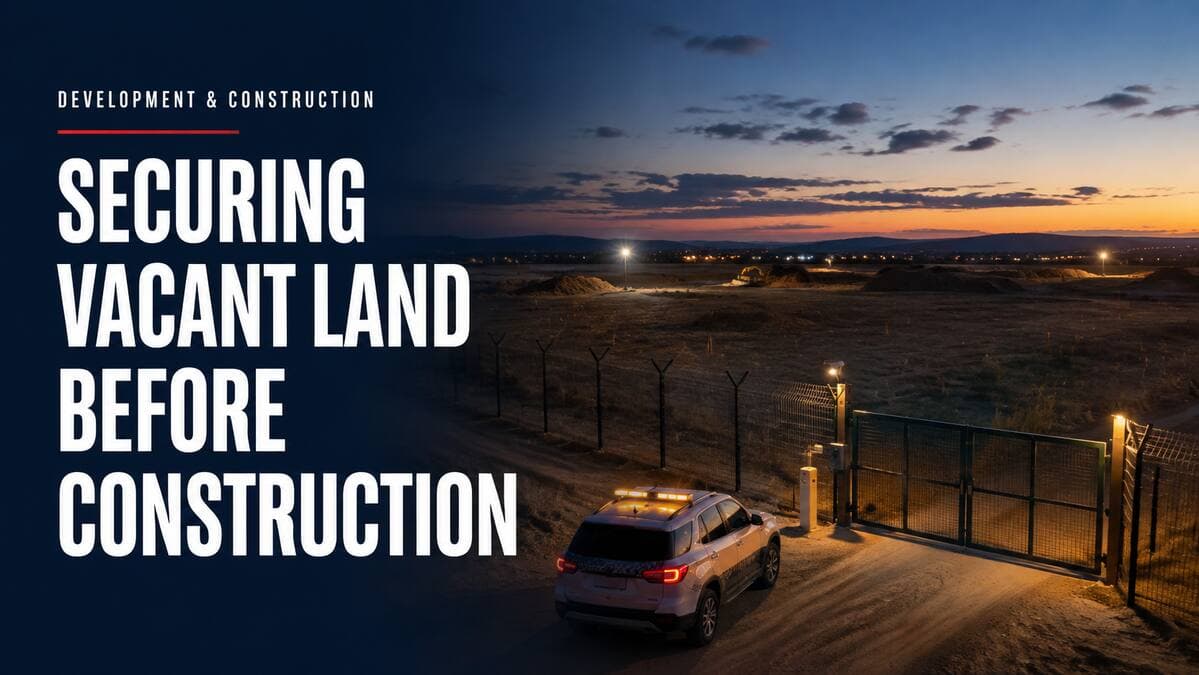

Most conversations about site security start once a building is already under construction — but vacant land and pre-development sites are frequently at their most vulnerable in the months before any construction activity begins. No structures, no on-site staff, and often limited fencing make undeveloped land an easy, low-risk target for illegal dumping, unauthorised occupation, theft of boundary materials, and vandalism.
Why vacant land gets overlooked
Developers and landowners often delay security spend until construction is imminent, reasoning that there's little on an empty site worth protecting. In practice, undeveloped land is exposed to a different set of risks: illegal dumping that becomes expensive to clear before building can start, informal occupation that can be legally complex and slow to resolve once established, and boundary encroachment that's far easier to prevent than to reverse. Communicare's experience securing vacant land in the Kuilriver Jacaranda area over several years is a good example of how sustained, proactive coverage — not just a response to incidents — keeps a site clean and ready for development.
What proper pre-construction site security actually involves
Effective security for vacant land and development sites typically covers a few core elements:
Scheduled patrols — regular, logged visits rather than a single static guard with nothing to monitor
Perimeter checks — confirming fencing, boundary markers and access points remain intact
Incident documentation — a clear record of any dumping, encroachment or unauthorised access, useful both operationally and if it ever becomes a legal matter
A visible deterrent presence — signage and a known, active security provider materially reduce opportunistic incidents
Transitioning security as construction begins
Once construction starts, site security needs evolve — material protection, contractor and visitor access control, and coordination with site management become priorities alongside perimeter security. A provider who has already secured the site through its vacant phase has a real advantage here: they already understand the site's specific risk points, access routes and history, rather than starting from zero once building begins.
The cost of getting this wrong
Clearing illegal dumping, resolving informal occupation, or replacing stolen boundary fencing all cost more — in time, money and delay — than the security spend that would have prevented them. For developers managing tight construction timelines, an unsecured vacant site is one of the more avoidable sources of pre-construction delay.
If you have vacant land or a development site that needs coverage before construction begins, we're happy to walk the site with you and put together a straightforward security plan — get in touch for a free assessment.
Frequently asked questions
Why does vacant land need security before construction starts?
Because it is frequently at its most vulnerable in the months before any construction activity begins. No structures, no on-site staff and often limited fencing make undeveloped land an easy, low-risk target for illegal dumping, unauthorised occupation, theft of boundary materials and vandalism.
What are the real risks on an empty site?
Illegal dumping that becomes expensive to clear before building can start, informal occupation that can be legally complex and slow to resolve once established, and boundary encroachment that is far easier to prevent than to reverse.
What does pre-construction site security actually involve?
Scheduled, logged patrols rather than a static guard with nothing to monitor; perimeter checks confirming fencing, boundary markers and access points remain intact; incident documentation useful both operationally and if it becomes a legal matter; and a visible deterrent presence, since signage and a known active provider materially reduce opportunistic incidents.
What changes once construction begins?
Material protection, contractor and visitor access control, and coordination with site management become priorities alongside perimeter security. A provider who secured the site through its vacant phase already understands its risk points, access routes and history rather than starting from zero.
Is securing vacant land worth the cost?
Clearing illegal dumping, resolving informal occupation or replacing stolen boundary fencing all cost more — in time, money and delay — than the security spend that would have prevented them. For developers on tight construction timelines, an unsecured vacant site is one of the more avoidable sources of pre-construction delay.

About JBA Security
JBA Security is a locally owned, PSIRA-registered (1685942) security company protecting estates, business parks, industrial and development sites across the Western Cape and Gauteng since 2008. The business is led by director Johan Brits, who served 23 years in the South African Police Service.
Old-school discipline. Modern security technology.